
(4) South Aisle and Anchorite’s Cell
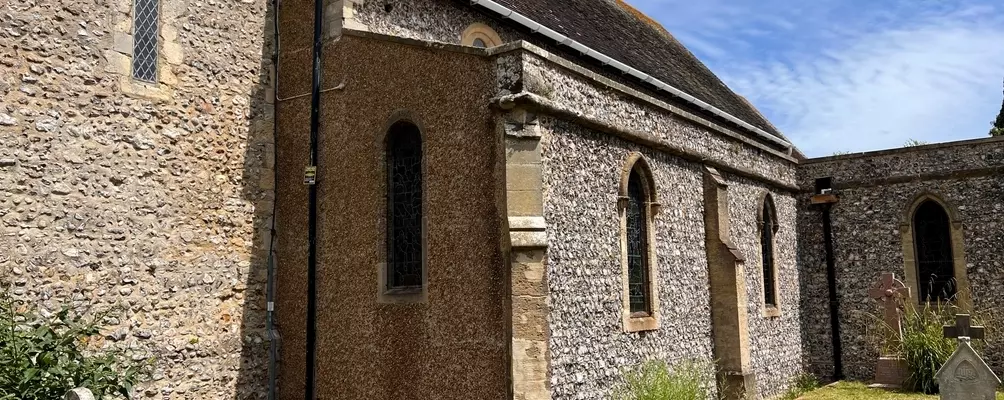
Moving around to the south side, the South Aisle was added in the 12th century (circa 1170). However, its outer wall and windows were completely rebuilt around 1850. As with the North Aisle, the South Aisle was once roofed in a continuous sweep from the nave roof. During the 1861 restoration, the aisles were given separate roofs. Note how the upper edge of the newer sloping roof slightly overlaps the bottoms of the nave’s quatrefoil windows. This suggests that the south-side quatrefoils may be older than those on the north side, whose stonework is entirely Victorian.
One of the most intriguing features associated with the church is the possible remains of an Anchorite’s cell. Anchorites flourished during the 12th and 13th centuries, living lives of prayer and seclusion. An unusual structure shown on the east end of the South Aisle in the 1791 drawing may represent this cell and could explain the presence of the low side window inside the chancel.
An Anchorite’s cell typically had three openings:
- one towards the altar,
- one through which food and drink were passed,
- and a third to admit light.
Known as “Ankers,” these holy men lived entirely within their cells, offering spiritual guidance and hearing confessions. Pilgrims travelling to the Holy Land would often seek their absolution, and even kings were known to confess their sins to Anchorites.